The Five-Step Disability Evaluation Process
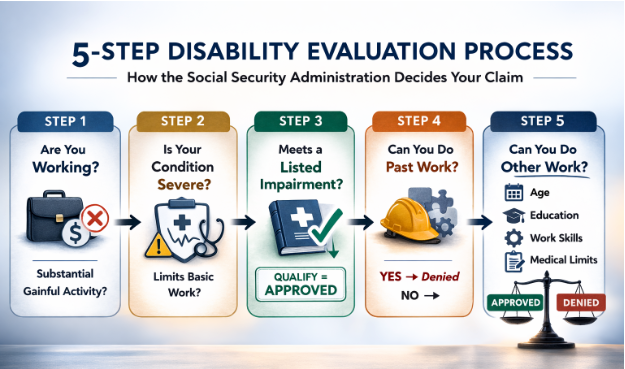
Here’s how SSA evaluates every disability claim:
Step 1: Are You Working?
If you are earning above the level considered “substantial gainful activity,” your claim will be denied.
Step 2: Is Your Condition Severe?
Your medical condition must significantly limit your ability to perform basic work activities.
Step 3: Does Your Condition Meet or Equal a Listed Impairment?
SSA maintains a Listing of Impairments. If your condition meets or equals one of those listings, you are approved at this step.
Step 4: Can You Perform Your Past Relevant Work?
If your condition prevents you from performing the jobs you’ve done in the past 15 years, the evaluation continues.
Step 5: Can You Perform Any Other Work?
This is where many claims are denied. At Step 5, SSA determines whether you can adjust to other work that exists in significant numbers in the national economy.
And this is where
education and transferable skills become critical.
Why Education Matters at Step 5
At Step 5, SSA considers:
- Your age
- Your Residual Functional Capacity (RFC)
- Your past work experience
- Your transferable skills
- Your education level
Education is also embedded in the
Medical-Vocational Guidelines, commonly called the “Grid Rules” (20 C.F.R. Part 404, Subpart P, Appendix II).
Depending on your age and work background, education can either strengthen or complicate your disability claim.
When Limited Education Can Help Your Case
Under the Grid Rules, individuals over age 50 may qualify for disability based on a combination of:
- Age category
- Physical limitations
- Past work type
- Education level
SSA defines “limited education” generally as formal schooling at or below the 11th-grade level.
Why does that matter?
Because the regulations assume individuals with limited education may have fewer opportunities to adjust to other work.
In certain grid categories, this can result in a direct finding of “disabled” - even if the person can still perform sedentary work.
For example:
- A 52-year-old with limited education, a history of heavy labor, and restriction to sedentary work may qualify under the grids.
- A 52-year-old with a college degree and similar medical restrictions may not qualify under the same grid category.
The system assumes greater adaptability with higher education.
When a College Degree Can Make Approval Harder
This is the part many applicants don’t expect.
If you have:
- A bachelor’s or advanced degree
- Skilled or semi-skilled work history
- Supervisory or administrative experience
SSA may assume you are capable of adjusting to other types of work - particularly sedentary, office-based, or clerical jobs.
Even if you cannot return to your previous employment, SSA may deny your claim at Step 5 by concluding:
“There are other jobs in the national economy you can perform.”
Education itself is not disqualifying. But it can influence how SSA evaluates your ability to transition to new work.
Transferable Skills: The Often-Overlooked Factor
Education alone does not drive Step 5 decisions. The real issue is
transferable skills.
Transferable skills are abilities gained from past work or education that SSA believes could be used in other occupations.
Examples include:
- Supervising employees
- Managing schedules
- Data entry
- Record keeping
- Customer service
- Technical or mechanical knowledge
- Using computers or software
- Administrative coordination
SSA may argue that these skills transfer to sedentary jobs such as:
- Appointment clerk
- Order clerk
- Receptionist
- Dispatcher
- Information clerk
- Surveillance system monitor
Even if you’ve never performed those specific jobs.
The Difference Between “Can Perform” and “Would Be Hired”
This is where the system often feels disconnected from real life.
Social Security Disability is not concerned with whether you could actually get hired. The legal question is whether jobs exist in significant numbers in the national economy that someone with your profile
could perform.
SSA does not consider:
- Local job availability
- Employer hiring preferences
- Gaps in employment history
- Competition in the job market
- Whether employers would choose a fully healthy applicant instead
The focus is theoretical capacity - not practical hiring outcomes.
However, this does not mean the analysis is automatic.
The law still requires that any job identified must be consistent with your documented medical limitations.
Why Transferable Skills Can Be Challenged
Just because you have education or past supervisory experience does not automatically mean skills transfer to sedentary work.
For example:
- A warehouse supervisor who managed staff while physically moving throughout the facility may not realistically transfer those skills to a desk-based clerical role.
- A teacher with chronic migraines and cognitive slowing may not sustain attention for data-entry or administrative work.
- A nurse with severe arthritis may have medical knowledge, but may be unable to sit, type, or maintain pace consistently.
Transferability depends on whether the skills are usable within your current physical and mental limitations.
This is where the Residual Functional Capacity (RFC) assessment becomes critical.
The Role of RFC in Overcoming Education Assumptions
RFC measures what you can still do despite your impairments.
It addresses:
- Sitting tolerance
- Standing and walking limits
- Lifting ability
- Concentration and persistence
- Interaction with others
- Stress tolerance
- Attendance reliability
If medical evidence shows:
- You would miss multiple days per month
- You cannot maintain concentration for two-hour blocks
- You require unscheduled breaks
- You cannot sit for prolonged periods
- You struggle with pace or persistence
Then even sedentary jobs may be eliminated under SSA rules.
Education does not override documented functional limitations.
Age Categories and Why They Matter
Age significantly impacts how education is applied.
- Under age 50: SSA assumes high adaptability.
- Ages 50–54: Grid Rules may begin to favor certain applicants.
- Age 55 and older: Regulations become even more favorable in some categories.
A 38-year-old with a master’s degree will face a different analysis than a 58-year-old with limited education and the same medical restrictions.
This is not about fairness - it is how the regulations are written.
What Research and Practice Trends Show
While SSA does not commonly publish approval statistics broken down solely by education level, vocational analyses and administrative research indicate:
- Lower educational attainment often correlates with higher grid-based approvals.
- Education has the greatest impact between ages 45–54.
- Younger applicants with higher education more frequently face Step 5 denials.
- Severe medical evidence reduces the influence of education on outcomes.
Education influences the vocational analysis - but it does not determine the result by itself.
Why Appeals Often Matter More for Educated Applicants
For applicants with higher education and skilled backgrounds, cases frequently hinge on Step 5 arguments.
At disability hearings:
- A vocational expert testifies about jobs someone “with your profile” could perform.
- Hypothetical questions shape the analysis.
- Transferable skills are debated.
An experienced disability lawyer can:
- Challenge whether skills truly transfer
- Question whether identified jobs align with RFC limitations
- Argue erosion of the occupational base
- Cross-examine vocational experts
- Apply Grid Rules strategically
Without legal representation, many applicants do not realize how technical Step 5 arguments can be.
The Bottom Line
So does education affect disability approval in Alabama?
Yes - it can.
For some individuals, limited education strengthens their claim under the Grid Rules.
For others, higher education may lead SSA to assume adaptability at Step 5.
But education alone never determines disability.
What ultimately matters is whether your medical impairments prevent you from performing sustained, full-time competitive employment under Social Security’s legal standards.
Don’t Let Assumptions About Your Education Cost You the Benefits You Deserve
Whether you have a college degree, technical training, a high school diploma, or limited formal education - your case must be evaluated within a complex regulatory framework.
Too often, people assume:
- “I went to college - I’ll never qualify.”
- “I didn’t finish school - I should automatically qualify.”
Both assumptions can be wrong.
If your claim has been denied - or if you’re unsure how your education affects your case - it’s important to understand how SSA will analyze your background at Step 5.
Disability appeals are not just about submitting more records. They’re about understanding how vocational rules, transferable skills, and medical evidence interact.
Before you apply - or before you appeal - make sure your case is being evaluated strategically.
Your education should not stand in the way of the benefits you’ve earned.